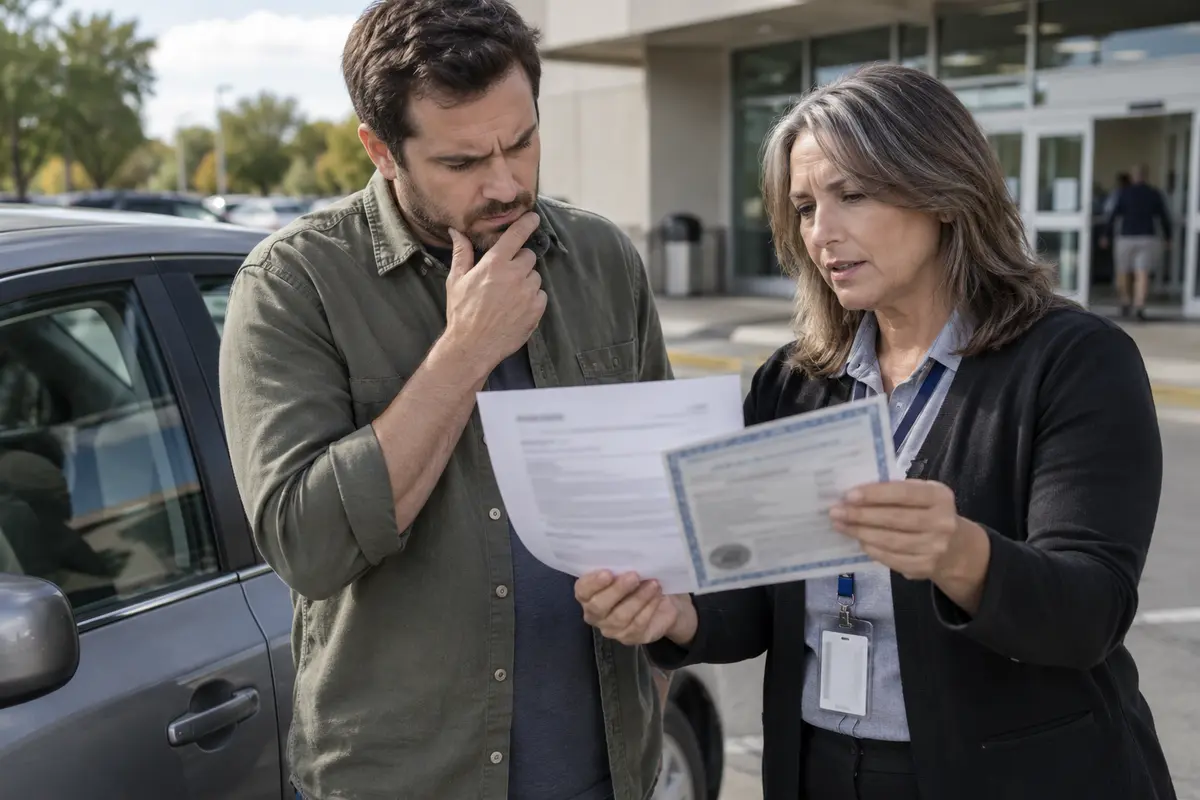
Finding a lien after you paid for a used car is an ownership problem, not merely a DMV inconvenience. A lien can be valid, already paid but never released, entered against the wrong record, or part of a broken title chain. Do not pay a stranger who claims to be the lender and do not hand the car back solely on a phone call. Verify the lien through the state title record and the institution identified there.
First decide whether the lien is live or stale
Ask the motor-vehicle agency what lienholder is recorded, when the lien was recorded, and what release evidence the state requires. Then contact the lienholder through a phone number or website you independently verify. Give only the information needed to identify the account. A legitimate lender may be limited in what it can disclose about another borrower, but it can often explain its lien-release procedure or confirm where a payoff/release document must originate.
| Evidence | What it can establish | What it cannot establish alone |
|---|---|---|
| Current state title record | Who the state recognizes as lienholder and owner | Whether the underlying debt is actually unpaid today |
| Lien release from recorded lender | That the lender authorized release | Whether the seller made other false statements |
| Seller payoff receipt | Possible payment of the debt | That the state record was properly updated |
| NMVTIS/title history | Brand/title history across participating state data | A complete private-lien search in every circumstance |
- Ask the state for its current title recordConfirm the recorded owner, lienholder, and any release requirement.
- Contact the named lender independentlyUse verified contact details and ask how an official payoff or release is issued.
- Compare the recordsSeparate a stale unreleased lien from a debt the lender still says is secured.
- Choose a response after verificationConsider seller cure, a documented payoff, or a claim based on the evidence.
Do not confuse “I paid the seller” with “the lender was paid”
A private sale can fail when the buyer gives the full price to the seller even though the seller promised to pay off a loan afterward. The cleanest structure is usually to involve the lienholder at closing: obtain an official payoff, direct the payoff amount to the lender using verified instructions, and pay only the remaining equity to the seller. After the fact, your choices depend on whether the seller can still satisfy the debt and obtain a release.
| Pay the seller, loan paid later | Close through the lienholder | |
|---|---|---|
| Where the money goes | The seller receives the full price | The lender gets the payoff and the seller gets the remaining equity |
| Payoff amount | Left to the seller's promise | An official payoff, sent using verified instructions |
| What can go wrong | The seller may never pay the debt or obtain a release | Much less exposure to a lien discovered after payment |
Slower than a parking-lot cash sale, and dramatically easier than litigating ownership afterward.
Build the seller claim around representations you can prove
Save the advertisement, messages, bill of sale, title copy and any statement that the vehicle was “paid off,” “clear title,” “no lien,” or similar. If the seller transferred a document that visibly listed the lien, the factual dispute differs from a case where the seller affirmatively concealed it. Write down when you discovered the lien and what the state and lender told you. If you later seek money from the seller, those contemporaneous records matter more than a reconstructed conversation.
Paying the lien yourself can be rational, but price the decision
Sometimes the lien balance is small enough that a buyer considers paying it to save the vehicle. Before doing so, get a written payoff directly from the recorded lienholder, understand exactly what release document will follow, and decide whether you can realistically recover that amount from the seller. Do not pay an unrelated collection account merely because someone says it “belongs to the car.” The goal is release of the recorded security interest, not payment of every debt the prior owner may have.
Do not assume there is an auto equivalent of home title insurance
Ordinary used-car closings usually do not include a separate title-insurance policy that automatically pays a buyer when an undisclosed lien appears. Specialty products or dealer promises may exist in a particular transaction, but the name alone proves nothing. If someone says “title insurance” will solve the problem, ask for the actual policy or contract, the licensed or regulated company standing behind it, the covered event, exclusions, claim deadline and maximum benefit. Do not pay a lien first on the assumption that an unnamed policy will reimburse you later.
If the lien looks fraudulent or the vehicle identity is inconsistent
Compare the 17-digit VIN on the dashboard, door label, title paperwork, history report and, where accessible, additional vehicle markings. A mismatch can indicate clerical error, altered paperwork, or VIN cloning. NICB warns that criminals can copy a VIN from a legitimate vehicle and use it to disguise a stolen car. Stop the transaction path and contact the appropriate state or law-enforcement channel if identity fraud or theft is plausible; do not attempt to “fix” a VIN discrepancy yourself.
- The 17-digit VIN on the dashboard
- The VIN on the door label
- The VIN on the title paperwork
- The VIN on the history report
- Any additional vehicle markings you can access
A mismatch can mean a clerical error, altered paperwork, or VIN cloning. Do not try to fix it yourself.
A lawyer becomes more useful when the amount and ownership stakes rise
Small claims can be practical for a straightforward money dispute within the state’s jurisdictional limit. It is less suited to a complex priority fight among an owner, lender and buyer, especially when the car is worth substantially more than the small-claims cap. If a verified lender is asserting a right to the vehicle and the seller cannot cure it, get state-specific legal advice before agreeing to surrender, payoff, or a new contract. The law of secured transactions and title varies enough that a generic website should not choose that remedy for you.
For the next purchase, make lien verification part of the closing rather than a question after payment. Match seller identity to the title, check the state record where available, ask how any lien will be released, and close through the lienholder when the seller still owes money. That sequence is slower than a parking-lot cash sale and dramatically easier than litigating ownership afterward.