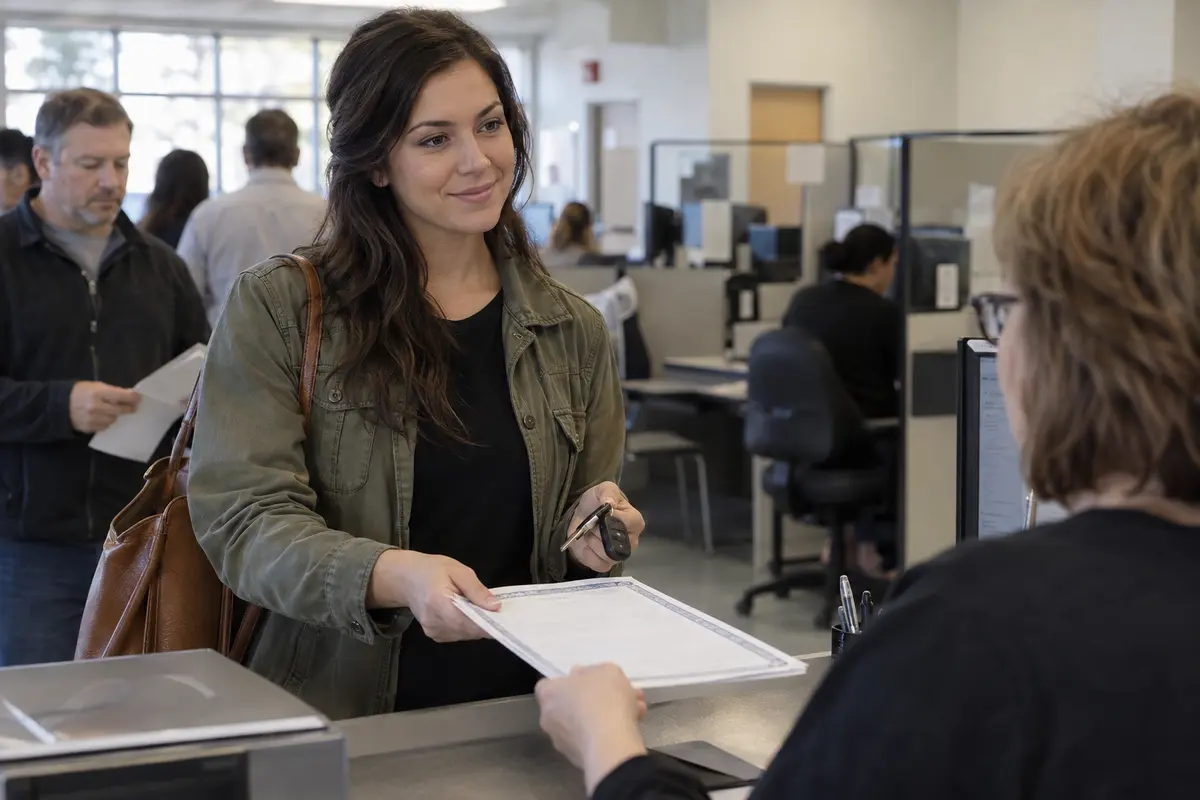
Title transfer is state law and state procedure, so there is no safe nationwide promise that every buyer has the same number of days, fees or inspection requirements. What can be standardized is the workflow: verify the assigned ownership document, resolve liens, complete required disclosures, calculate state tax and fees, submit the transfer application, and save proof until the new title arrives.
The six-step transfer sequence that works as a framework
- Confirm the VIN, owner names, brands and lien information on the title you received.
- Make sure every required seller, co-owner and buyer field is completed without alterations.
- Collect odometer, bill-of-sale, emissions, VIN-inspection or notarization documents your state requires.
- Arrange insurance and any registration or plate requirement needed before operating the vehicle.
- Submit the title/registration application with the correct tax and government fees by your state deadline.
- Save receipts and track the title until the state record shows you as owner.
California illustrates why buyer and seller clocks can differ
California DMV currently says a private-party buyer has 10 days after purchase to transfer ownership, while the seller has five days to report the transfer. The buyer commonly needs the signed title, odometer record for covered vehicles, smog certification where applicable, fees and use tax. Those details are California examples, not instructions for a Texas or New York purchase. The moment your purchase crosses state lines, check both the current title state and the state where you will register.
Texas uses a different deadline and encourages a joint filing
TxDMV says vehicles must be titled in the buyer’s name within 30 days of sale and encourages an individual seller to accompany the buyer to the county tax office so staff can identify title or salvage issues. Texas also changed dealer temporary-tag practice in 2025, replacing paper temporary tags with metal plate procedures. That is exactly the kind of state-specific operational detail that goes stale if a national article pretends one checklist fits every DMV.
These examples are state-specific and can change; they are not a nationwide filing deadline.
New York shows how disclosures can become title conditions
New York DMV’s buyer guidance describes odometer and damage disclosures and rebuilt-salvage handling in its own title system. The state also warns private buyers to check lien information. Rather than memorizing a national list, download the buyer-state DMV checklist for the exact transaction type—private party, dealer, gift, inherited vehicle, out-of-state title, lien payoff or rebuilt vehicle—and build your file from that.
Notary, smog and VIN checks attach to different parts of the transaction
Do not ask only, “Does this state require a notary?” Ask which document and which transaction triggers it. Arizona’s current title guidance, for example, says a seller signature on the back of an Arizona paper title must be witnessed by an MVD customer-service representative or notarized unless the vehicle is sold to a dealership. California private-sale guidance lists a smog certification among the transfer items, subject to its exemptions and vehicle-specific rules. VIN or identification inspections can arise in out-of-state, imported, rebuilt or identity-problem transactions in some states. These are separate gates: a smog certificate does not validate ownership, and a notarized signature does not prove the VIN or lien status.
| Variable | Why it changes by state | What to verify |
|---|---|---|
| Deadline | State statute/DMV process | Exact buyer filing deadline |
| Tax base | Sales/use tax method differs | Purchase price vs presumptive/fair-market rules |
| Emissions/VIN check | Regional/state programs differ | Whether inspection precedes title/registration |
| Notarization | Some titles/forms require it | Which signatures must be notarized |
| Plates/permits | State plate system differs | How you may legally drive home |
| Lien release | Paper/electronic title systems differ | Acceptable proof and processing path |
If the title is rejected, a prior lien remains, or the ownership chain is broken, Cleartitle Guide is the deeper state-by-state research path; this page stays at the buyer-workflow level.
Do not wait for a mailed title before checking that the filing was accepted
Keep the DMV or county receipt and any temporary registration in a folder with the bill of sale, payment proof and title copy. If the agency offers online status, check it. A missing document caught on day three is easier to fix with a reachable seller than a rejection discovered weeks later after the seller has moved or stopped responding. If the office rejects a signature or lien release, ask for the exact deficiency in writing or note the form number staff identifies.
A cross-state purchase needs an extra planning call
Before traveling for an out-of-state private car, call or use official online guidance from the state where you will register it. Ask what proof lets you drive it home, whether a VIN inspection is required, how the out-of-state title must be assigned, and how tax credit works if tax was collected elsewhere. Do this before payment because a seller may remove plates and your home state may not recognize the same permit system.
Three examples show why national deadline charts age badly
Use state examples only to learn what must be checked. California currently tells private-party buyers to initiate transfer within 10 days and sellers to report the transfer within five days. Texas says the vehicle must be titled in the buyer’s name within 30 days and routes private buyers through county tax offices. New York has its own title, odometer and damage-disclosure rules. None of those numbers should be copied into a generic checklist for another state. A nationwide deadline table can become wrong after one legislative or administrative change, while the DMV page is the operational source that gets updated. Save or print the relevant state instruction on the day you buy, especially for an out-of-state purchase. If the transaction date is close to a regulatory change, use the agency’s current page and call if the online wording is ambiguous.
Treat the transfer receipt as part of the vehicle’s permanent file, not something to throw away once plates arrive. It can establish when you submitted the transaction, what taxes or fees were paid, and which documents the agency accepted. If the mailed title later contains a misspelled name, wrong lienholder, incorrect mileage notation, or other error, compare it with that receipt and your copies before contacting the agency. Correcting a clean clerical mistake is usually a very different problem from curing a missing seller signature or unresolved lien. Keeping the original paper trail lets you describe the problem precisely instead of restarting the ownership story from memory.