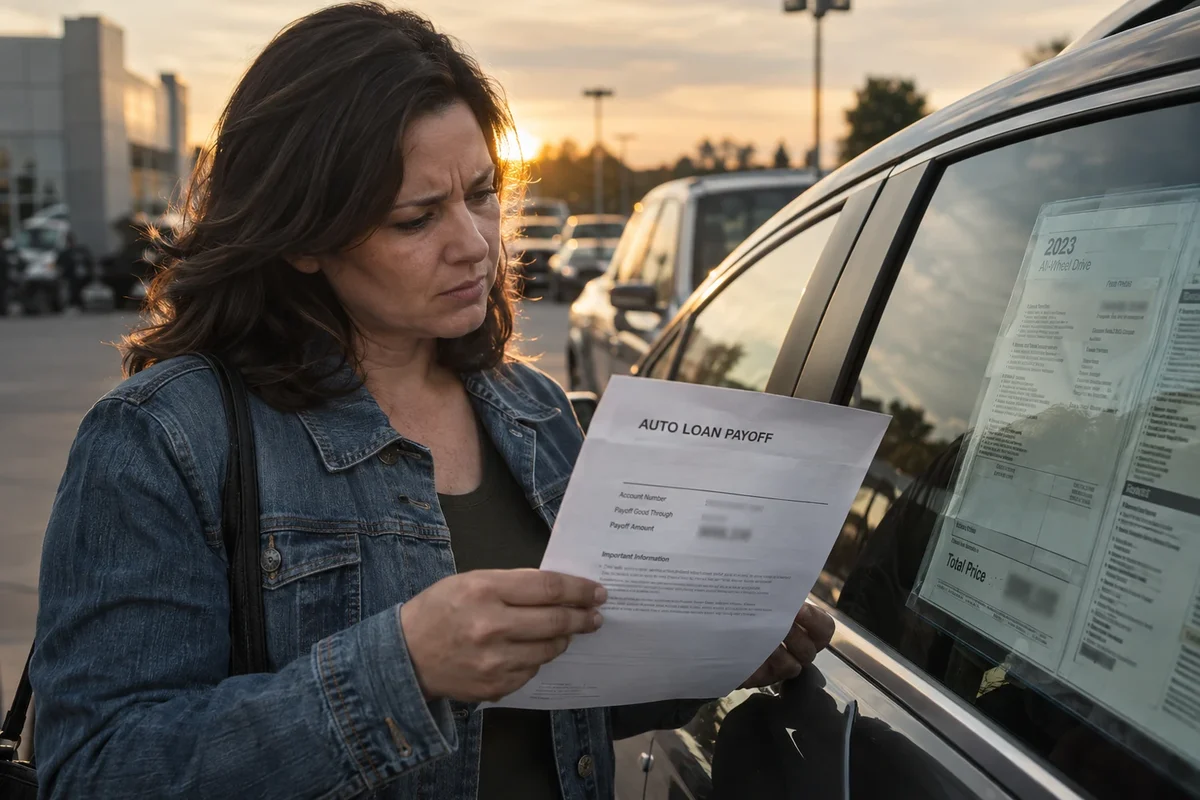
Owing more on your current car loan than the car is actually worth — negative equity, or being "upside down" — is now genuinely common: in the final quarter of 2025, roughly 30% of trade-ins carried negative equity, with the average amount owed hitting an all-time high of $7,214. If you're trading that car in toward a used-car purchase, understanding exactly what happens to that gap matters more than most buyers realize before they sign.
What actually happens to the negative equity
When your trade-in is worth less than what you still owe, you have two options: pay the difference out of pocket at the time of sale, or roll it into your new loan. Rolling it over means you start the new loan already underwater on day one — your new loan balance includes not just the price of the car you're buying, but also the leftover debt from the car you just gave up.
Why this compounds rather than just adding a flat amount
The extra negative-equity amount doesn't just sit there as a flat addition; it accrues interest for the full life of the new loan the same as the rest of the balance does. A common pattern: you're buying a $30,000 vehicle, but because you're rolling over debt from your previous loan, you end up financing closer to $37,000 — and that gap can add over $2,000 in extra interest across the loan term while keeping you underwater on the new vehicle for its first two to three years, precisely the period when a new-to-you vehicle is also depreciating fastest.
Extending the loan term makes the math worse, not better
A dealer facing pushback on a monthly payment that feels too high, inflated by rolled-over negative equity, will often offer to stretch the new loan to 72 or 84 months to bring the payment down to a number that feels manageable. This solves the immediate affordability problem while making the underlying math worse: a longer term means more total interest paid, a slower pace of building real equity in the new vehicle, and a longer stretch of time spent underwater before the loan balance finally drops below the vehicle's depreciating value.
A dealer's generous trade-in offer deserves the same scrutiny
An unusually high trade-in offer relative to independent valuations you've researched is worth double-checking rather than simply welcoming — dealers sometimes offer an inflated trade-in value specifically to make an underwater trade-in look neutral or even positive on paper, then recover that same amount by marking up the new vehicle's price or the loan's interest rate. Compare the deal's three separate numbers — trade value, payoff, new vehicle price — against your own independent research on all three before accepting that a generous-looking trade offer is actually a good deal overall.
The repossession risk is not hypothetical
A 2024 Consumer Financial Protection Bureau report found that consumers who rolled negative equity into new financing were 1.5 times as likely to have their car repossessed within two years compared to those who didn't. Starting a loan already underwater removes the cushion that normally lets a struggling borrower sell or trade out of a problem loan without taking a loss — you're stuck with a car worth less than you owe on it, with less room to maneuver if your financial situation changes.
Lender approval limits can block this entirely
Lenders commonly cap total financing at around 110% to 120% of the vehicle's actual sale price. A large negative-equity rollover can push your total financed amount past that ceiling, meaning the loan may simply be denied outright, or the dealer may require a substantial cash down payment to bring the deal back within the lender's limit — which is often the first real signal to a buyer that the rollover amount has become a genuine problem, not just a manageable inconvenience.
How the rollover can get obscured in the deal structure
A dealer can structure a deal so the rolled-over negative equity isn't obvious on a quick glance — folded into an inflated 'sale price' on the new vehicle rather than shown as its own line item, or offset against an inflated trade-in value that looks generous but is actually just absorbing the shortfall. Always ask for the deal worksheet to show your trade-in's actual agreed value, your old loan's exact payoff amount, and the new vehicle's price as three separate numbers — if any of the three seems unusually favorable relative to what you researched independently, the other two numbers are worth checking twice.
What to actually do if you're underwater on your current car
- Get a real payoff quote from your current lender and an honest trade-in or private-sale value estimate before you ever walk into a dealership — know your actual gap in dollars before any sales conversation starts.
- If the gap is small, consider paying it off in cash rather than rolling it over, even if that means delaying the new purchase by a few months to save the difference.
- If you must roll it over, ask the dealer to show the negative equity as a separate, clearly labeled line item on the deal worksheet, not folded silently into the vehicle price.
- Consider whether delaying the purchase to let your current loan balance drop further, or your trade-in's value stabilize, meaningfully shrinks the gap.
- If you're not underwater yet but might be soon, avoid extending your current loan term further (a refinance that lowers your payment but extends the term can deepen negative equity rather than fixing it).
Get the real payoff number, not your statement balance
If you're not sure whether you're currently underwater, request a 10-day payoff letter from your lender rather than relying on your last statement balance — a payoff letter includes any per-diem interest and fees that a monthly statement balance doesn't reflect, and it's the number a dealer will actually use to calculate your real trade-in gap during negotiations.
Sometimes the cheapest option is to wait
Finally, run the total cost of ownership for the new loan — principal, rolled-over negative equity, and total interest across the full term — against simply keeping and continuing to pay off your current vehicle a while longer. Sometimes the least expensive option is the one that involves no new purchase at all, even if the current car isn't the one you'd ideally want to be driving right now.