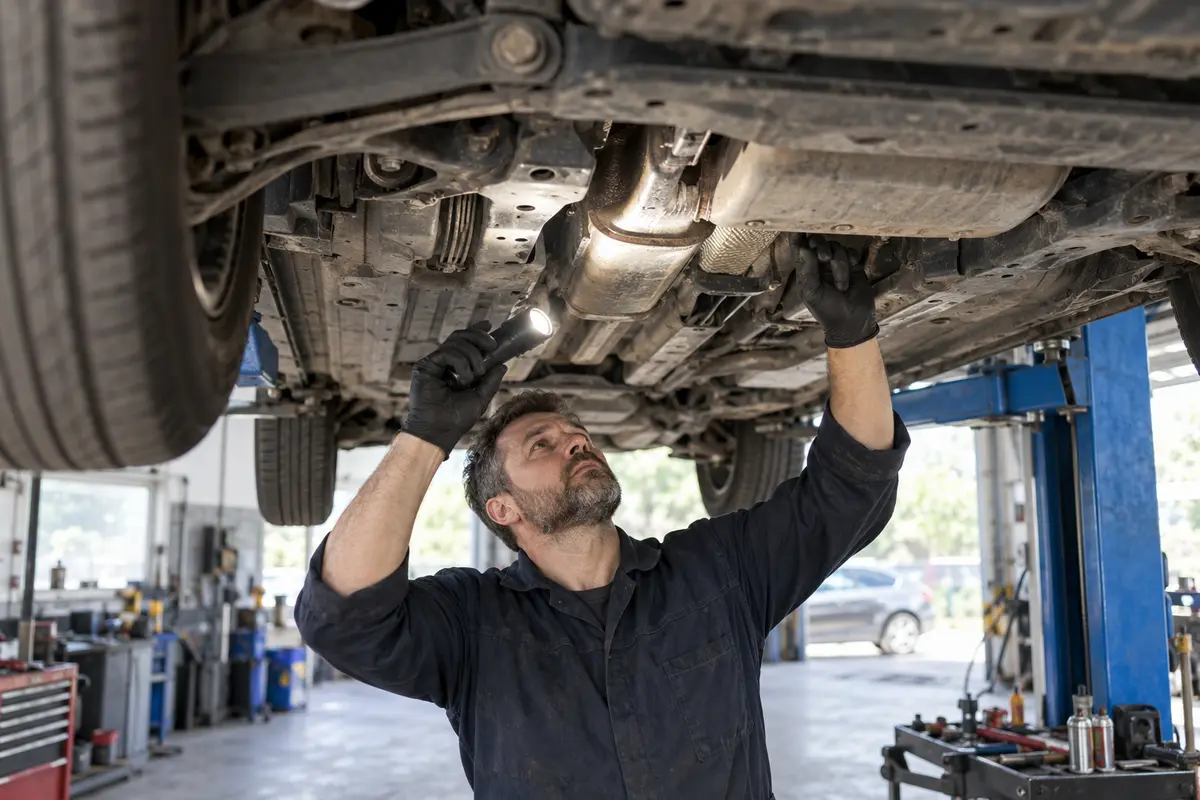
A pre-purchase inspection is a condition snapshot performed for the buyer before money and title change hands. It should go well beyond “check the engine.” A useful inspection covers the powertrain, leaks, cooling system, brakes, tires, suspension, steering, underbody, structural repair evidence, electronics, scan-tool data, road behavior and the maintenance items likely to become your first bills. Consumer Reports’ March 2026 used-car inspection guide says a thorough third-party PPI is typically about $100–$150, while Edmunds describes a broader $100–$200 range. Treat those as current national reference points, not a quote for your car: a complex European model, diesel truck, hybrid or EV can require a specialist and additional diagnostics.
Before booking, ask what the quoted inspection actually includes. A useful shop should be able to tell you whether the car will go on a lift, whether it will be road-tested, whether diagnostic codes and readiness monitors are checked, and whether brake/tire measurements or photos are recorded. Price alone is a weak comparison if one inspection is a driveway visual check and another includes underbody access and model-specific diagnostics. For hybrids, EVs, diesels or performance cars, ask what specialist equipment or battery/high-voltage checks are available and what would cost extra.
Choose the inspector before you become emotionally committed
Call a shop that is independent from the seller and familiar with the model. Tell the shop you are buying, not selling, and ask whether it performs pre-purchase inspections routinely. A seller who insists that only “their mechanic” can look at the car removes the independence that makes the service valuable. Mobile inspectors can be practical, but a full shop has a lift and more diagnostic equipment; choose based on the risk profile of the car.
- Ask what the quoted inspection includesConfirm lift access, road test, codes and readiness monitors, measurements and photos.
- Match the shop to the vehicleAsk whether it knows the model and whether a hybrid, EV, diesel or performance car needs specialist equipment.
- Name targeted risksAsk the mechanic whether symptoms or model history justify compression, leak-down or other advanced tests.
- Request a usable reportAsk for measurements, photos and findings ranked by urgency, not only a good/bad label.
A useful inspection has at least 25 concrete checkpoints
- Cold-start behavior, smoke, unusual noises and warning lights.
- Engine and transmission fluid level, condition and visible leaks.
- Cooling system hoses, radiator, reservoir and signs of overheating.
- Battery test, charging voltage and starting system.
- OBD scan for current, pending and recently cleared codes where supported.
- Brake pad/rotor condition, fluid leaks and parking brake.
- Tire tread, age/date codes, mismatched brands and uneven wear.
- Wheel bearings, steering play, ball joints, bushings and shocks/struts.
- CV boots, axles, driveshaft components and differential leaks where applicable.
- Exhaust condition, catalytic-converter tampering and abnormal noise.
- Underbody rust, fresh undercoating over corrosion and impact damage.
- Frame/unibody rails, aprons, welds and fasteners for repair evidence.
- Paint/body-panel alignment, glass dates and signs of prior bodywork.
- Headlights, signals, wipers, windows, locks, seats and safety equipment.
- HVAC temperature and blower operation.
- Infotainment, cameras, parking sensors and driver-assistance warnings.
- Seat-belt operation and visible airbag/SRS warning status.
- Fluid/service labels and maintenance evidence.
- Engine mounts and abnormal vibration.
- Transmission shift quality on the road.
- Steering centering and pull under steady driving.
- Brake vibration, noise and straight-line stopping behavior.
- Acceleration under load and driveline vibration.
- Cabin water leaks, mildew odor and damp carpet.
- Model-specific known trouble areas identified before the appointment.
Compression and leak-down tests are targeted tools, not automatic line items
A standard PPI does not always include engine compression or leak-down testing because those procedures take more time and may not be justified on every car. Ask the mechanic to recommend them when symptoms, model history or oil consumption raise concern. The same applies to borescope inspection, cooling-system pressure tests, hybrid battery diagnostics and advanced scan-tool functions. The right inspection escalates when evidence points to a specific risk rather than charging for every possible test on every vehicle.
Ask for numbers, photos and severity—not just 'good' or 'bad'
A report is much more useful when tire tread is recorded in 32nds, brake material is measured where practical, fault codes are listed, leaks are photographed and each finding is classified as safety-critical, due soon, monitor, or cosmetic. A “needs tires” note could mean $500 or $1,500 depending on size and specification. Quantified findings let you obtain a repair estimate and decide whether to negotiate, budget or walk away.
| Finding | Decision question | Typical response |
|---|---|---|
| Safety issue | Can it be safely corrected before delivery? | Require repair or walk |
| Major powertrain risk | Is diagnosis conclusive and price-adjustable? | Usually pause purchase |
| Wear due soon | What will it cost in first 6–12 months? | Add to ownership budget |
| Cosmetic defect | Do I care enough to pay to fix it? | Negotiate only if relevant |
| Unknown code/history | Can the seller explain with records? | Diagnose before signing |
The seller’s refusal is information you should price at 100%
If a seller will not allow an independent inspection, do not try to discount your way around the uncertainty. You are being asked to purchase an expensive mechanical system without the test that could reveal expensive faults. A reasonable seller may set boundaries—appointment time, proof of insurance, nearby shop, or accompanying the car—but an absolute refusal is a strong reason to leave. The cost of missing one transmission, structural or flood issue can dwarf the inspection fee.
A remote inspection needs a chain of custody, not just a PDF
If the car is hours away, arrange the inspector yourself and have the report delivered directly to you. Confirm the VIN in the appointment, ask for time-stamped photos of the dashboard, VIN labels, underbody and any defect called out, and find out whether the inspector actually road-tests the vehicle. A seller-provided inspection can be useful background, but it is weaker evidence when the seller selected the inspector and controls the report. Autotrader’s April 2026 PPI guidance notes that mobile inspection services can make out-of-state purchases practical; the useful part is the independent workflow, not the logo on the service.
Turn the report into a decision within hours
After the inspection, call the mechanic rather than reading only the checklist. Ask which finding would stop the mechanic from buying the car, what will likely need attention within a year, and which items are normal for age. Price the urgent work using the same shop or another credible estimate. Then compare the adjusted total cost with your alternatives. Do not let a $150 inspection become psychologically tied to buying; paying to discover a bad car is a successful inspection.
How to turn a $150 inspection into a $1,400 decision
Assume a mechanic charges $150 and reports that the car is structurally sound, has no active powertrain faults, but needs two tires immediately, front brakes within six months and an overdue transmission service. Local written estimates total about $1,400. The seller’s price was already at the top of your market range. You now have three rational choices: ask for a price reduction supported by the report, ask the seller to complete specified work and provide receipts, or buy only if the $1,400 fits your ownership budget. What you should not do is say “the inspection passed” and ignore the findings. A PPI is not pass/fail testing. It converts hidden future spending into present information, and that information is valuable even when the car has no catastrophic defect.
One more useful question is whether the shop actually inspected the parts that matter for this model. A generic multipoint check can miss known failure points that require removing an undertray, checking a specific fluid condition, measuring battery state, or using a manufacturer-capable scan tool. Before the appointment, spend five minutes looking up the maintenance schedule and common inspection points for the exact engine, transmission, hybrid system, or EV battery. Give that list to the mechanic without telling them what conclusion you want. A good PPI combines a broad safety and condition screen with a few model-specific checks; it should not be a seller-friendly oil-change inspection with a nicer name.
The article's example: structurally sound, but tires, brakes and a transmission service are due.