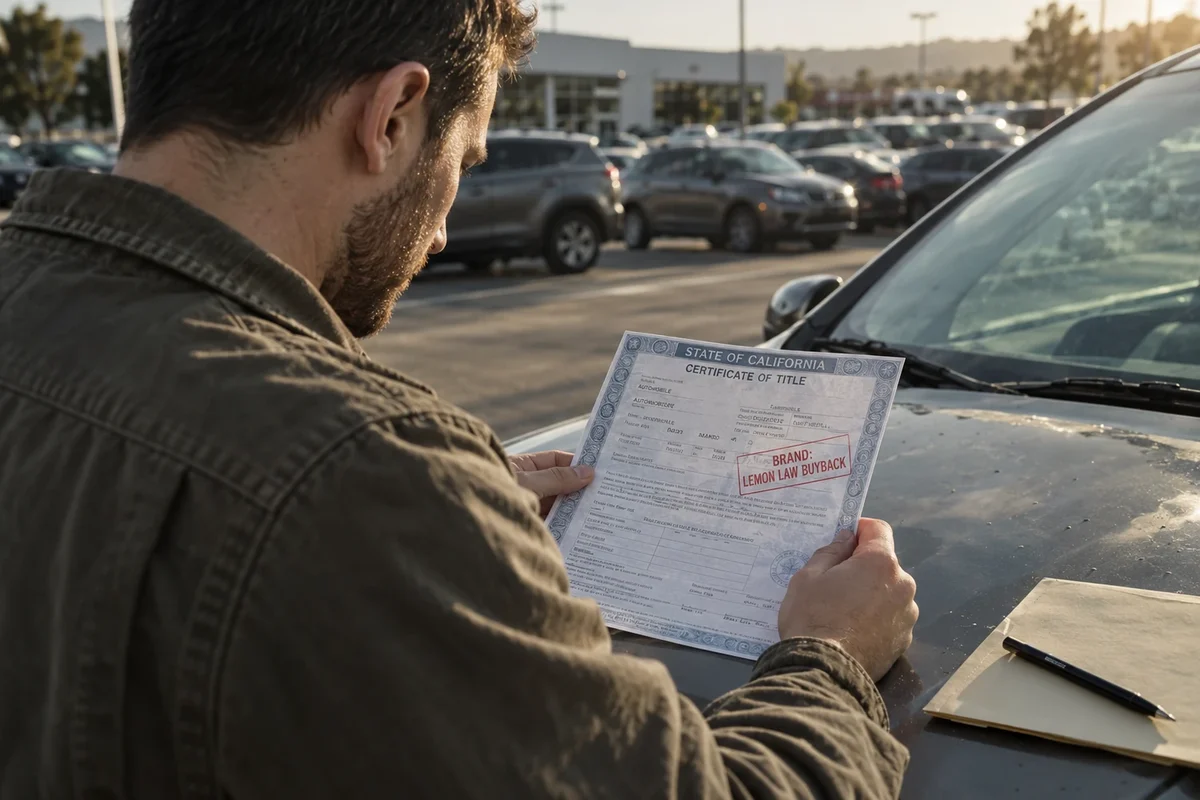
A "lemon law buyback" or "manufacturer buyback" vehicle is one the manufacturer took back from an earlier owner after repeated, unresolved warranty problems, then reconditioned and resold. Manufacturers are legally allowed to resell these vehicles — they are not automatically banned from the road — but the title has to carry a disclosed brand, and specific past problems generally have to be disclosed to the next buyer.
How a vehicle becomes a lemon law buyback in the first place
A manufacturer repurchases a vehicle after a warranty dispute is resolved through arbitration, a settlement, or a court decision under a state's lemon law — typically because the same defect went through a defined number of repair attempts without being fixed, similar to the repair-attempt standard used in used-car lemon laws generally. Once repurchased, the manufacturer reconditions the vehicle and can legally put it back into the resale market, subject to the disclosure and title-branding rules discussed below.
Reconditioning standards vary by manufacturer
There's no single federal reconditioning checklist a manufacturer must follow before reselling a buyback vehicle — the specific repairs, parts replacement, and quality inspection process are set by the manufacturer's own internal policy, which can vary meaningfully between brands. This is part of why the disclosed repair list matters so much: it's your best window into whether the underlying defect was actually addressed with a real fix or a more limited repair aimed at getting the vehicle back through inspection.
What has to be disclosed at resale
Requirements vary by state, but a common model — California's, for example — requires disclosure identifying the vehicle by year, make, model, and VIN; stating explicitly whether the title is marked "Lemon Law Buyback"; describing each nonconformity the original buyer or lessee reported; and listing the repairs made to correct each issue. This is meaningfully more detailed than a generic "as is" or "reconditioned" label — a properly disclosed buyback should tell you specifically what was wrong and what was done about it, not just that it was previously returned.
The title brand and how to check for it
States participating in the National Motor Vehicle Title Information System (NMVTIS) are required to report title brands, including lemon law buyback designations, which helps reduce "title washing" — the practice of re-registering a branded vehicle in a state that doesn't carry the brand forward, hoping it disappears from the record. Run the VIN through an NMVTIS-approved vehicle history provider before buying any used car with a history you can't fully verify from the seller directly; a clean-looking title in your own state doesn't guarantee the vehicle was never branded in a different state along the way.
What to do if you discover a buyback brand after you already bought
If you find a lemon law buyback brand on your own vehicle's title after the sale — through your own later NMVTIS check, a lender's title search, or an attempted resale — and it wasn't disclosed to you at purchase, that's a potential fraud or non-disclosure claim independent of anything related to the vehicle's mechanical condition. Document exactly what you were told at the time of sale, pull the vehicle's actual title history, and consult a consumer attorney in your state about non-disclosure claims specifically, since the legal theory here is about what you weren't told, not about whether the car has since had problems.
How much this affects value
A confirmed lemon law brand can reduce a car's resale value by roughly 15% to 40%, sometimes more, because buyers reasonably expect a higher chance of recurring reliability issues even after reconditioning. This is a real, quantifiable discount you should expect and can negotiate around — a seller asking clean-title market price for a disclosed buyback vehicle is asking you to pay for a risk profile the title itself says is different.
A buyback is not the same thing as a car that was simply traded in with problems
A vehicle a previous owner traded in because they were personally unhappy with it, even due to real recurring problems, is not automatically a lemon law buyback — that brand applies specifically to a manufacturer repurchase resulting from a formal lemon law process (arbitration, settlement, or court decision). A car with a rough ownership history but no formal buyback determination won't show a lemon law brand on NMVTIS, which means the absence of that specific brand doesn't guarantee a clean mechanical history — it only rules out this one specific category of past problem.
What to actually verify before buying a disclosed buyback
- Get the specific list of nonconformities that triggered the buyback, not just a general acknowledgment that it was one.
- Get documentation of the specific repairs made to address each listed nonconformity before resale.
- Run an independent NMVTIS-based VIN check yourself rather than relying solely on the seller's disclosure paperwork.
- Have a pre-purchase inspection done by a mechanic independent of the seller, focused specifically on the systems tied to the originally disclosed defects.
- Price the vehicle against the documented buyback discount range, not against clean-title comparables for the same year and model.
How to ask about an undisclosed prior buyback
If a seller describes a vehicle as previously 'bought back' without using the specific term 'lemon law buyback,' ask directly whether the repurchase was the result of a formal lemon law process or simply a manufacturer goodwill repurchase for an unrelated reason — the two are not interchangeable, and only the former carries the specific title-branding and disclosure requirements discussed here.
Use the brand as a negotiating point
When comparing two otherwise-similar used cars where one carries a disclosed buyback brand and one doesn't, treat the brand as a genuine negotiating lever, not just a disclosure to note and move past — the documented discount range gives you a concrete, defensible number to bring into price discussions rather than a vague sense that the car is "worth less."